The Logistics of Orbit

A Deployment Economics™ Framework for the Cislunar Ecosystem

Published by Development Economics X

Discover how our global network of Developmenauts™ are mapping out the world’s first Spatial Economic Zones (SEZs), and how emerging markets can leapfrog traditional rocketry to capture high-value sectors in the orbital supply chain.

The Death of the Kilometer

For centuries, development economics has treated physical distance as the primary tax on trade. From the silk routes of antiquity to modern maritime shipping lanes, the cost of moving goods has been fundamentally tied to kilometers traveled.

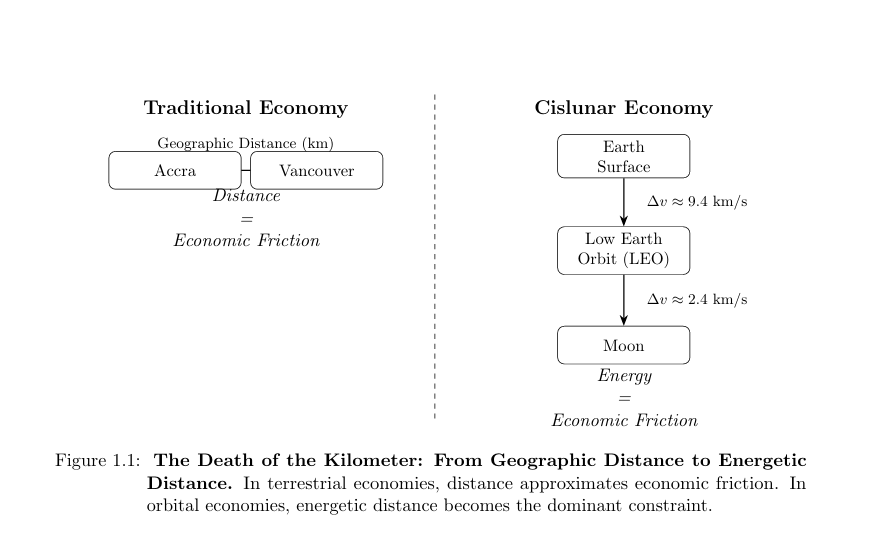
As capital allocations transition beyond Earth’s atmosphere into the cislunar ecosystem—the economic sphere spanning Low Earth Orbit (LEO), Geostationary Orbit (GEO), and the Moon—this foundational assumption collapses. Physical distance is no longer a reliable metric for economic friction. In extraterrestrial markets, distance is measured in energy, quantified as Delta-V ($$\Delta v$$), the velocity change required to shift a payload from one orbital trajectory or celestial body to another.

Traditional Trade:   Kilometers Traveled ──> Direct Cost Driver
Orbital Trade:       Delta-V (Energy)    ──> Direct Cost Driver

This whitepaper establishes a rigorous macroeconomic framework for evaluating the emerging space economy through the lens of development economics. By mapping classic terrestrial development constraints—such as the Gravity Model of Trade, institutional leapfrogging, infrastructure bottlenecks, and the resource curse—onto the cislunar environment, we provide capital allocators, sovereign funds, and policymakers with a strategic blueprint to navigate and monetize the next frontier of global capital.

Redefining the Gravity Model of Trade

In terrestrial economics, the standard Gravity Model predicts that trade volume between two economies is directly proportional to their economic mass and inversely proportional to the physical distance between them:

$$T_{ij} = A \frac{M_i M_j}{D_{ij}}$$

Where:

$$T_{ij}$$ is the trade flow between economy i and economy j

$$A$$ is a constant

$$M$$ represents economic mass (GDP)

$$D_{ij}$$ is the physical distance between them

In the cislunar economy, substituting physical distance $$D_{ij}$$ into this equation yields absurd economic conclusions. For example, a spacecraft traveling from Low Earth Orbit (LEO) to a high Earth orbit covers tens of thousands of kilometers, yet requiring far less fuel than a rocket traversing the mere 100 kilometers from Earth’s surface to LEO.

To make the Gravity Model mathematically and commercially viable for space, we must replace physical distance with Delta-V $$\Delta v,$$ representing the energy tax of escaping gravity wells.

The Real Cost of Escaping the Well

Earth possesses a deep, unforgiving gravity well. Launching raw materials or heavy components from the Earth’s surface into LEO requires an enormous $$\Delta v$$ expenditure (approximately $$9.4 \text{ km/s})$$. Conversely, launching the exact same mass from the surface of the Moon into LEO requires a fraction of that energy (roughly $$2.4 \text{ km/s}$$), despite the Moon being nearly 400,000 kilometers away.

The In-Space Manufacturing (ISM) Cost-Benefit Threshold: Manufacturing and resource extraction become economically superior to Earth-baseline imports the moment the cost of localized processing drops below the structural cost of paying Earth’s $$\Delta v$$ tax.

Trade RoutePhysical DistanceApproximate Δv CostEconomic Friction Rating
Earth Surface to LEO~100 km$$\sim 9.4 \text{ km/s}$$Extremely High (Massive Fuel Penalty)
Lunar Surface to LEO~384,000 km$$\sim 2.4 \text{ km/s}$$Low (Highly Efficient Extraction Route)
Asteroid (NEA) to LEOMillions of kmVariable $$(< 1.5 \text{ km/s})$$Very Low (Optimal for Bulk Raw Materials)

This creates an immediate, structural economic advantage for space-based resource extraction. A lunar mining outpost or an asteroid harvesting operation is geographically distant but energetically proximate to orbital markets. Over time, trade routes will bypass Earth entirely, forming an isolated, self-sustaining cislunar supply chain where raw inputs move efficiently between low-gravity nodes.

The Logistics of Orbit:

A Development Economics X Framework for the Cislunar Ecosystem

Traditional Trade Model
Metric: Kilometers (km)
Vancouver Accra
Geographic Friction: Traditional economics measures distance linearly. In space, this assumption completely fails.
The New Cislunar Map
Metric: Delta-V (Δv)
Earth LEO Hub Moon > 9.4 km/s ~ 2.4 km/s
Energetic Proximity: Launching from the Moon to LEO requires far less energy than launching from Earth, bypassing the heavy gravity tax.

The “Big Push” Model for Space Infrastructure & Dual-Use Capital

In traditional development economics, Paul Rosenstein-Rodan’s “Big Push” theory posits that a developing economy cannot break out of a low-income equilibrium through small, isolated investments. Instead, it requires a massive, synchronized injection of capital into public infrastructure—roads, power grids, and ports—to create economies of scale and enable private enterprises to become profitable.

Low-Investment Trap ──> Coordinated "Big Push" ──> Market Viability ──> Self-Sustaining Growth

Cislunar space currently sits in a classic low-investment trap. High launch and operational costs suppress market demand, while low market demand prevents the scaling required to lower operational costs. Breaking this cycle demands a coordinated “Big Push” focused on orbital and lunar infrastructure, structured through modern Public-Private Partnerships (PPPs).

Identifying the Cosmic Infrastructure Bottlenecks

Just as a landlocked terrestrial nation cannot export goods without rail networks and deepwater ports, an orbital economy cannot mature without three foundational public goods:

  • Propellant Depots (The Gas Stations of Orbit): Currently, rockets must carry all the fuel required for their entire journey from Earth’s surface, drastically limiting payload capacity. Orbital fuel depots allow vehicles to launch “light” from Earth, refuel in LEO, and proceed to deep space with maximum cargo efficiency.
  • Power Grids (The Lunar Night Problem): A lunar night lasts 14 Earth days, plunging surface operations into freezing darkness. Deploying surface nuclear micro-reactors or orbital solar-power satellites represents a public utility that no single mining company can afford to build alone, but which unlocks all commercial surface operations.
  • Standardized Logistics Nodes (The Intermodal Container of Space): Terrestrial global trade exploded with the invention of the standardized shipping container. Space requires standard docking interfaces, power couplings, and data protocols to achieve the same interoperability.

De-Risking Capital via Advanced Market Commitments (AMCs)

Sovereign entities (such as G7 nations via the Artemis Accords or the African Union Space Agency) can trigger this Big Push without resorting to inefficient state-run monopolies. The most lucrative mechanism to achieve this is the Advanced Market Commitment (AMC)—a tool originally designed by development economists to incentivize pharmaceutical companies to develop vaccines for neglected diseases.

The Space AMC Model: A coalition of governments commits to purchasing a fixed quantity of a resource (e.g., metric tons of lunar water ice or megawatt-hours of orbital solar power) at a guaranteed price before the infrastructure is built.

This guaranteed demand creates a predictable revenue stream, transforming highly speculative space ventures into bankable assets. Private equity and venture funds can confidently underwrite infrastructure loans, knowing a sovereign buyer underpins the market baseline.

Dual-Use Spatial Economic Zones (SEZs)

To maximize the economic spillover, these core infrastructure nodes should be designated as Spatial Economic Zones (SEZs). In these designated zones—such as the Lunar South Pole or specific Lagrange points—operators benefit from:

  1. Regulatory Sandboxes: Streamlined liability, fast-tracked spectrum allocation, and harmonized safety standards.
  2. Shared Capital Assets: Publicly funded landing pads and communications relays, drastically lowering the capital expenditure (CapEx) barrier for new, specialized market entrants.

By treating orbital infrastructure as a coordinated public utility rather than a series of disconnected private assets, the cislunar economy can rapidly transition from a government-subsidized frontier to a self-sustaining commercial ecosystem.

The Cislunar Dutch Disease & Price Elasticity

Theoretical hypotheses*.

Commodity Price Volatility & Market Solutions

Navigating the Extraterrestrial Resource Curse

The Terrestrial Import Trap
Dumping Asteroid Platinum on Earth
Price Supply (Q) Baseline +10,000% CRASH
The Dutch Disease Scenario: Inelastic terrestrial demand means an exponential supply shock of platinum-group metals causes an immediate, catastrophic price collapse.
The In-Situ Solution (ISRU)
Capturing Value Within the Cislunar Ecosystem
Lunar Ice Outpost LEO Fuel Depot Satellite Network ISRU Value = Terrestrial Launch Savings
Avoiding the Gravity Tax: By bypassing Earth completely and utilizing space resources directly in orbit, commodities maintain immense value by displacing astronomical launch costs.

In development economics, the “Resource Curse” or Dutch Disease explains a destructive paradox: when a country discovers a massive windfall of natural resources, its currency appreciates rapidly, making its other domestic sectors (like manufacturing or agriculture) uncompetitive globally, ultimately hollows out the wider economy.

As private operators advance toward commercial asteroid extraction—targeting Near-Earth Asteroids (NEAs) rich in Platinum Group Metals (PGMs) and rare-earth elements—terrestrial economics faces an unprecedented supply-side shock.

Massive Resource Windfall ──> Supply Shock ──> Drastic Price Deflation ──> Terrestrial Market Collapse

If a single, small M-type (metallic) asteroid contains trillions of dollars worth of platinum at current market prices, the actual monetization of that asset requires navigating the brutal realities of price elasticity of demand.

The Paradox of Trillion-Dollar Asteroids

The media frequently touts individual asteroids as being worth “trillions of dollars.” However, these valuations are built on a fundamental economic fallacy: multiplying the astronomical volume of the asteroid’s mass by the current spot price on Earth.

Traditional commodity markets are highly price inelastic in the short term. When supply expands exponentially without a corresponding shift in structural demand, prices do not drop linearly—they collapse exponentially.

$$\epsilon_d = \frac{\% \Delta Q}{\% \Delta P}$$

Where:

$$\epsilon_d$$ is the price elasticity of demand

$$\% \Delta Q$$ is the percentage change in quantity demanded

$$\% \Delta P$$ is the percentage change in price

Because the global terrestrial demand for metals like platinum, rhodium, and iridium is limited by current industrial applications (catalytic converters, electronics, jewelry), introducing thousands of tons of asteroidal supply $$\% \Delta Q \gg 0$$ will push $$\% \Delta P$$ toward zero. The trillion-dollar asset quickly becomes a multi-billion-dollar storage liability.

Mitigating the Terrestrial Supply Shock

To protect global markets from catastrophic deflationary shocks, capital allocators and space-faring nations must deploy two distinct stabilization frameworks borrowed from developmental macroeconomics:

  1. Sovereign Resource Sterilization Funds: Similar to Norway’s Government Pension Fund Global or Ghana’s Heritage Fund, space-mining entities must systematically “sterilize” the capital influx. Instead of dumping raw metals directly onto terrestrial spot markets, resources must be tokenized, held in strategic reserves, or metered out via algorithmic supply caps to match global demand growth.
  2. The In-Situ Paradigm Shift (ISRU): The most economically viable path avoids Earth altogether. The true value of space resources is not found by dragging them down into Earth’s gravity well, but rather via In-Situ Resource Utilization (ISRU).

The Macroeconomic Rule of ISRU: Extraterrestrial commodities should be valued by the cost of the Earth-launch weight they displace, not by their Earthly spot price.

Resource TypeTerrestrial ApplicationCislunar (ISRU) ApplicationTrue Economic Value Driver
Water/Ice (40% of 2026 Market Focus)Low-value utilityLiquid Oxygen/Hydrogen PropellantDisplaces the $9.4 \text{ km/s}$ Earth escape tax
Platinum Group MetalsIndustrial catalysts, ElectronicsRadiation shielding, Structural AlloysEnables local manufacturing without launch costs
Volatiles / RegolithLow valueRadiation shielding, 3D printed habitatsEliminates bulk transport costs across cislunar space

By prioritizing ISRU, the space economy avoids triggering Dutch Disease on Earth. Instead of disrupting terrestrial mining economies, asteroid-derived materials form the structural foundation of an isolated, self-sustaining cislunar trade network—capturing immense value exactly where it is harvested.

Conclusion: Framing the First Spatial Economic Zones (SEZs)

As the structural realities of Delta-V and resource extraction dictate the transition from isolated missions to an interconnected orbital market, the immediate challenge is institutional. Capital does not enter a legal vacuum. To unlock sustained private investment, the international community must transition from vague governance to the implementation of Spatial Economic Zones (SEZs).

Mirroring the Special Economic Zones that accelerated terrestrial emerging markets, SEZs in cislunar space will act as geographically defined regulatory sandboxes. Strategically placed at high-value orbital nodes (such as the Lunar South Pole or Earth-Moon Lagrange Points), these zones will offer a harmonized legal framework backed by three operational pillars:

  1. Deconfliction Safety Zones: Building directly on the operational frameworks outlined in the Artemis Accords, SEZs will establish transparent, non-exclusive safety zones. These boundaries ensure that heavy industrial activities, such as regolith excavation or asteroid processing, do not cause harmful electromagnetic or kinetic interference with neighboring capital assets.
  2. Asset-Backed Tokenization & Collateralization: Because international space law prohibits sovereign national appropriation of celestial land, SEZs will pioneer alternative property-rights frameworks. Capital infrastructure—such as orbital fuel depots and surface nuclear reactors—will be legally recognized as private, transferable property, allowing them to be tokenized and collateralized to secure terrestrial institutional financing.
  3. Standardized Interoperability: To minimize transactional friction, any operator entering an SEZ must adhere to open-architecture standards for power couplings, data links, and docking interfaces, transforming localized hardware into a shared, modular public utility.

The Macroeconomic Imperative: A Global Architecture

The creation of a cislunar economy must not be limited to legacy G7 aerospace powers. The geopolitical landscape of 2026 demonstrates an unprecedented globalization of space policy. With over 65 nations now party to the Artemis Accords and the African Space Agency (AfSA) actively executing its strategic phase from its headquarters in Cairo, the entry barriers to the space ecosystem have fundamentally shifted.

For emerging economies, the cislunar frontier represents the ultimate technological leapfrogging opportunity. Just as developing nations bypassed physical telecommunications grids to build mobile-first financial systems, they can now bypass the capital-intensive demands of heavy rocket manufacturing. By focusing on specialized niches—such as satellite data analytics for climate-resilient agriculture, specialized AI for autonomous orbital manufacturing, or hosting critical equatorial ground-telemetry infrastructure—emerging markets can capture high-value positions in the interstellar supply chain.

Terrestrial Leapfrogging: Skip Landlines   ──> Mobile-First Economies
Cislunar Leapfrogging:    Skip Rocketry    ──> Data & Ground Architecture

Ultimately, space-based development economics is not an escape from Earth’s challenges; it is a catalyst for terrestrial resolution. The closed-loop, zero-waste efficiencies required to survive a lunar night will directly yield the technological blueprints needed to conquer water scarcity, clean energy distribution, and resource depletion on Earth. By applying rigorous macroeconomic frameworks to the orbital frontier, we ensure that the expansion of human capital beyond the atmosphere creates an inclusive, highly lucrative, and sustainable tide that lifts both established and emerging economies alike.

About Development Economics X

Development Economics X is a premier global macroeconomic research and strategy company. We bridge the gap between advanced industrial frameworks and rapid emerging-market technological leapfrogging. By applying rigorous economic data, institutional analysis, and frontier logic, we model and de-risk the future of global capital—both on and off Earth.

Contact & Inquiries:

Development Economics X: contact@developmnenteconomicsx.com

DEVELOPMENT ECONOMICS X